What inspired you to want to tell this particular story?
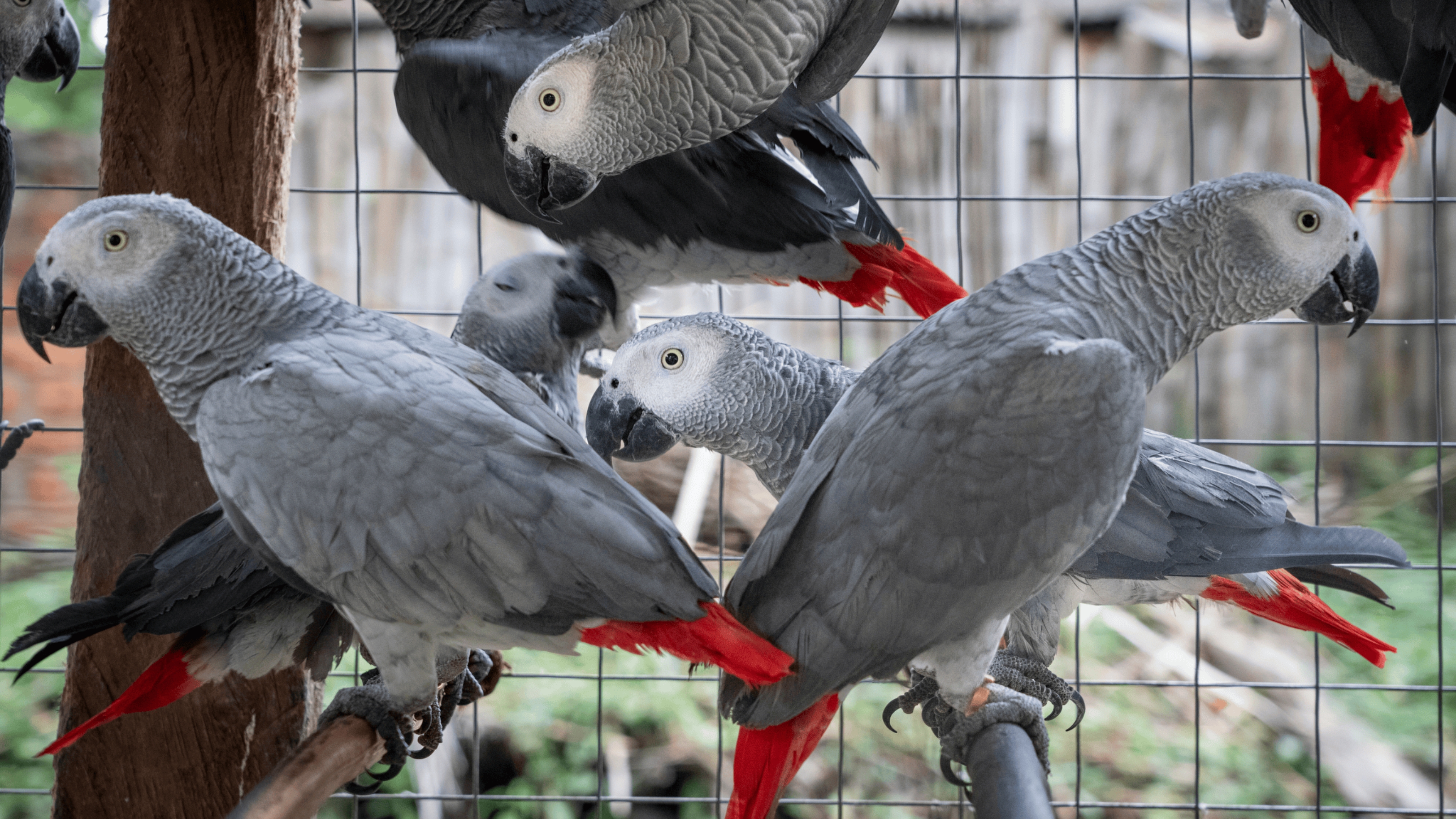
Rene Ebersole: I’ve long been fascinated with that topic of self-recognition and animal intelligence. It had been in the back of my mind for quite a while that African Grey Parrots were the world’s smartest birds, and that they were very self-aware. So when we came up with the idea for WIRE, I said, “I know exactly what story I want to do.” And I sort of went straight into it — I didn’t even wait until we had all the funds to do it. I got one grant, and then boarded a plane to Africa.
Can you tell me a bit more about what went into producing this story?
RB: I did a lot of research at the outset, and I realized that I wanted to look at the full supply chain. I knew that the Democratic Republic of Congo was still the stronghold for the wild populations, but because of that it’s also the place where so many individuals are being smuggled from. I also knew that South Africa was the world’s biggest supplier of African Greys, and that they were supplying a lot of the ones going to the Middle East, which is the world’s largest buyer of African Greys.
So the shape of the reporting started to make sense that I would go to the DRC and South Africa and the UAE. And as you’re reporting, you’re meeting people along the way and finding out who your characters could be, and that unfolded basically over the course of a year.
Was it challenging reporting from the DRC? [The country experienced a violent offensive launched by the rebel group M23 in late 2025.]
It’s not an easy place to travel. On my reporting trip in spring 2024, we went to South Africa first, and when I was there, we received word that there had been some violence in Kinshasa, [DRC’s capital city], and people were trying to overtake the government. And we wondered, is it even safe to go? Fortunately, we received word that it was safe, and so we went. It’s very challenging to come and go on local flights — sometimes the planes only fly every Tuesday, and then if one flight gets canceled, you’re stuck for another week. Things worked out for us to come and go when we needed to. On top of the conflict, poverty is a big challenge for the DRC and many people don’t have access to water. For most of the trip, we had no running water — bucket showers, pit toilets. The DRC is a rugged experience, but it was also a really interesting and informative and rich experience.
Much of the illegal trade in parrots and other wild species happens on the same social media apps that are also inspiring people to buy these animals. Do these social media companies bear some responsibility for this?
My reporting shows a lot of people think the social media industry has responsibility for this. There are a lot of loopholes that let companies and individuals share this type of stuff on their platforms, and one of them is not restricting speech. And I fully believe in free speech. But the social platforms are complicit in facilitating illegal wildlife trading, and they’re not working with law enforcement.
What happens is, when somebody reports that they found something illegal, the social media company will take it down. And that seems like a good thing, right? But the reality is, a lot of these traders, if they’re selling something illegally, they probably have a fake ID, and they just pop right back up with another fake ID. People say it’s like a game of Whack-A-Mole. A lot of investigators are doing their investigations that way, because people advertise this stuff wide out in the open. You don’t even have to be a friend of theirs — you can see what they’re offering for sale, and when they take it down, then that investigator’s evidence goes away.
Some people would say that the platforms need to work more closely with investigators. But there’s also just not enough people to look into this — not enough inspectors at the ports or the borders, or enough investigators actually monitoring what’s going on online.
So did you do some of your own research through social media?
Yeah, I always have. For this story in particular, I reached out to a few people who really track what’s going on. There’s three people that I’ve worked with who are, combined, probably monitoring thousands of accounts. Smaragda Louw in South Africa sent me the identification for some of the people she’d been tracking, so I was able to see what they were selling online.
And people are willing to talk: It always surprises me how people let you in. For a lot of people, in their world of commodifying animals, this is just normal. When you contact them about doing an interview, they’re proud of their business. They’re open, they’re welcoming, they don’t see a problem with what they’re doing. It often surprises me that people aren’t a little bit more cautious. We’re not there to sandbag anyone, we’re there just to provide a lens to this trend, but still they know that there’s a risk of bringing attention to themselves from being featured in the media. Yet they’re confident in what they do, and they’re not afraid to talk about it.
Could you explain how this new ability to test a parrot’s microbiome could impact the trade?
A lot of people are familiar with the fact that if you have a diverse gut microbiome — aided by eating a healthy diet and spending lots of time outdoors — you tend to be healthier. A researcher at the University of Colorado Boulder, Valerie McKenzie, had found that she was able to tell very clearly by looking at parrots’ microbiomes if they had lived in captivity versus in the wild. The ones who lived in the wild had eaten a varied diet, got lots of exercise, and their microbiome looked very different compared with the ones who were raised in captivity and had spent their all their days in a tiny cage eating commercial bird food being treated with antibiotics. And then there were the ones in between — the ones who have come from the wild and who are now spending time in captivity, and their microbiomes look pretty distinct as well. She’s developing this as a forensic tool; as the technology gets better, hopefully a test of a poop sample on the spot will be able to tell if a bird’s microbiome is more aligned with one that’s been raised in captivity — as it should be in legal trade — versus one that was taken from the wild.
The researcher sent me a box of sampling equipment, and I stuck it in my suitcase and took it with me to South Africa. We went behind the scenes at the airport and tested the shipments, which was the first time the technology had been used forensically. That was really exciting, and it was interesting that we did find some samples that were suspicious.
That being said, this is not something that could currently be used to say that someone is guilty or innocent. This technique is not fully baked yet — it needs to be tested a lot more until it’s scientifically rigorous enough to be accepted in court. There’s a grant right now that the World Parrot Trust is leading — they’re doing a study on a much broader scale in multiple countries, and working to train law enforcement and get this into a systemized technique.
What was the impetus for creating WIRE?
WIRE is a nonprofit organization that started about two years ago, with me and two other journalists, Oliver Payne and Rachael Bale, who were working for National Geographic on their Wildlife Watch series. When that series ended, we felt really passionately that this type of reporting is still needed — and not just short-form stories about wildlife or environmental issues. These are in-depth investigations: We spend nine months to a year on them, and they have to warrant that type of investment. We also feel strongly that having the visual depiction of what’s going on helps people connect with it, so we really work hard to make sure that we’re featuring great photography and film.
We’re telling these stories to help the public realize that there’s a biodiversity crisis. There are a lot of threats to wildlife, and also there are things that people can do to help combat them. But simultaneously there’s this crisis in journalism, where newsrooms are declining and there’s just not a lot of support. So we’re providing the stories that a lot of publications can’t afford to do now, and so far, the response has been pretty enthusiastic.
To learn more about WIRE and be among the first to hear about the team’s upcoming stories (including spotlights on marine fisheries and the Amazon), sign up for WIRE’s email list.